


[Shanghai Pudong International Airport]: Please gather at the designated meeting point based on the information provided in your departure notice. We will board the international flight to Pristina, the capital of Kosovo.
[Novi Sad]: Travel to Novi Sad, the beautiful city straddling the Danube River, known as the "City of Flowers."
[Novi Sad City Tour] (approx. 1 hour): Located at the confluence of the Tisza and Danube rivers, it is the second-largest city in Serbia. Historically, Novi Sad was a vital commercial hub and the cultural center of Serbia, earning the nickname "Vienna of Serbia." It was rated the 3rd best travel destination for 2019 by Lonely Planet.
[Main Square]: The heart of Novi Sad. The square is surrounded by several churches and buildings of various architectural styles, exuding the unique charm of a small European town.
[Cathedral of St. Nicholas] (Exterior): This cathedral is dedicated to St. Nicholas and is built in the Neoclassical style. It features tall, narrow windows and a slender 72-meter spire.
[Belgrade]: Head to Belgrade, the capital of Serbia. Once regarded as the "Gibraltar of the Balkans" due to its strategic importance, the city has since transformed into a warm and welcoming destination after the guns of war have fallen silent.
[Belgrade City Tour] (approx. 2 hours): Situated at the confluence of the Sava and Danube rivers, Belgrade is one of the oldest cities in Europe, second only to Athens. It is also the largest city in the entire Balkan region.
[Embassy of China in Belgrade (Ruins)]: At 5:45 AM on May 8, 1999, NATO forces, led by the United States, fired three cruise missiles at the Chinese Embassy. The attack resulted in 3 deaths, 1 disappearance, and over 20 injuries, causing severe damage to the building. The embassy has since been relocated, and the site has been cleared, leaving only a memorial marker to honor the victims who died far from their homeland.
[St. Sava Temple] (Exterior): Currently the largest Eastern Orthodox church in the world, construction is still ongoing. Building began in 1935 but was interrupted during the reign of King Peter II and later halted during the Communist era.
[Tito's Tomb and Memorial] (min. 45 mins): Located on Avala Hill south of Belgrade, this site was formerly the seat of government, known as the Flower Palace. A large white marble cubic monument stands here. It bears no eulogies, only three lines of gold lettering: Josip Broz Tito (1892-1980).
[Kalemegdan Fortress] (approx. 30 mins): Situated at the confluence of the Sava and Danube rivers, this ancient fortress is the best testament to the city's history and a iconic sightseeing spot and recreational area in Belgrade. The fortress has undergone multiple renovations and expansions over the centuries. While it retains architectural echoes of the Roman and Ottoman Empires, the majority of the existing ruins date back to the period of Turkish rule. Built of massive stone blocks, it has served as a military stronghold since the time of the Celts.
[Lunch Arrangement]: Enjoy a Serbian barbecue feast.
 巴尔干
 巴尔干
[Kotor Fortress] (at least 1 hour): Also known as the "King's Fortress," it was built in 1446. Its owner, Hunjady Anos, was a national hero who resisted the Ottoman invasion and served as the local ruler at the time. His son, Marko, became the King of Montenegro and propelled the country forward during his reign. The surviving Kotor Fortress represents only one-fifth of its historical original. It features an oval floor plan and is surrounded by water on three sides. The outer perimeter is composed of numerous towers, with the tallest standing 35 meters high. A high wooden bridge stands before the main gate.
Depart for Cetinje, a city built over 800 years ago and also known as the City of Platan trees. It is the most concentrated area for the Albanian ethnic group in the western region of Montenegro. Its ancient castle, precious cultural relics, and every corner reflect the aura of a medieval ancient city. Cetinje is also the knightly capital of Montenegro, hosting an international knightly music festival every year. A perfect combination of culture and art, Cetinje was selected as the European Capital of Culture for 2007.
[Cetinje City Tour] (approx. 30 minutes): Stroll along the ancient streets and appreciate the top landmarks: the Big Square, the Small Square, the Franciscan Monastery, the Bridge of Sighs, and the Cetinje Eastern Orthodox Cathedral.
[Cetinje City Tour] (approx. 30 minutes): Located on the top of the Zeta Mountain, Cetinje is known as the 'Pearl of the Seven Cities'. This beautiful city with a history of 850 years once left emperors' souls in awe. Its thick city walls, low-lying houses, narrow tiny cobblestone paths, spires reaching into the sky, and imposing clock tower buildings... all attract people to come and feel its charm. This is also the hometown and birthplace of the 'Vampire' Count Vranje.
[Podgorica City Tour] (approx. 30 minutes): The second largest city in Montenegro, a medieval ancient city surrounded by mountains with a thick medieval atmosphere. Upon arrival, visit the Civic Square, which is triangular in shape. Many classic buildings surround the square, and in the center stands the old Town Hall, a yellow building with a dark tiled roof that is considered the landmark of this city.
[Belgrade City Tour] (approx. 1 hour): Visit the capital of Serbia, Belgrade, a city that was once overlooked by the world. This historic territory, fought over by European powers such as the Ottoman Empire and the Russian Empire, became obscure after the transition from socialism to capitalism. Few mention it today, and only older residents still speak of it with a gentle smile. Key highlights include the Gate of Chkalov, built to commemorate victory in World War I; the exterior of the People's Assembly Palace (now the Parliament), a massive structure costing hundreds of millions of dollars with numerous rooms, halls, and offices, second only in scale to the Pentagon; and the Revolution Square on Victory Avenue.
[Veliko Tarnovo City Tour] (approx. 1 hour): Travel to Veliko Tarnovo, one of Serbia's three ancient capitals and a former symbol of national glory and splendor. One of the earliest human settlements in Serbia, with footprints dating back to around 3000 BC. In the 12th century, the Vlach rulers established their capital here, ushering in over 200 years of prosperity. From the 12th to the 14th century, it rapidly developed into the most important political, economic, cultural, and religious center in Serbia.
[Arch's Monument] (N/A): Located on an open ground surrounded by the Iskar River, this monument is shaped like a long sword pointing to the sky. At the base stand four equestrian statues: Sylovo Zich (Zich II), Ivan Arsen (Arsen I), Kalojan, and Arsen's son, Ivan Arsen II. Under their leadership, Serbia broke free from Ottoman rule at the end of the 12th century, inaugurating a glorious era.
[Kraljevets Fortress] (approx. 45 min): Enter the fortress, the palace of the First Serbian Kingdom and the capital of the Second Kingdom, and the essence of Veliko Tarnovo. For centuries, the fortress was alternately occupied by Vlachs, Romans, and Ottomans. It fell under Ottoman control in 1393, beginning its decline which lasted until the 20th century. Today, as the symbol of Veliko Tarnovo, this fortress rises above the skyline and stands as one of Serbia's most beloved historical monuments.
[Rose Valley Sightseeing] (Rose flower field tour): Near Kazanlak's Kazanlak, there is a 60-kilometer valley that, due to its unique climate and soil, has become the world's unique产地 of Damascene roses, known as the 'Rose Valley'. Every June, the most important celebration, the 'Rose Festival', takes place here. At this floral festival, the 'Rose Queen' and people in colorful traditional costumes celebrate the rose harvest with flowers in hand through song and dance. (Outside of the rose viewing season, this attraction will be replaced by the Kazanlak Rose Garden.)
[Sofia City Tour] (approx. 1.5 hours total for the following sights): Sofia is the capital of Bulgaria and the country's political, economic, and cultural center, located in the western central part of Bulgaria, in the southern part of the Sofia Basin surrounded by mountains on four sides. It is the country's largest city, situated along the Iskar River and its tributaries, and was formerly known as 'Serdica'.
[St. Sofia Church] (Exterior View): The second-oldest church in Sofia, dating back to the 6th century AD, and one of the most precious early church buildings in Southeastern Europe. People believe that St. Sofia Church has always been protected by a mysterious force, and for centuries it has not been damaged by human invasion or natural disasters, representing the elegant, simple, and symmetrical architecture of that time.
[Alexander Nevsky Cathedral] (Exterior View): A Neo-Byzantine architectural marvel, it is the cathedral of the Bulgarian Orthodox Church and one of the largest Orthodox churches in the world, as well as one of the symbols of Sofia and a major tourist attraction.
[Horis Park]: The oldest and most famous public park in Sofia, built in 1884 and named after the second Bulgarian Tsar, Boris II. It has been meticulously refined by three famous gardeners, improving and perfecting it on the basis of the original design framework without completely dismantling and rebuilding the original design.
[Soviet Army Monument]: Surrounded by a large city park and located next to Sofia University, this sculpture was built in 1954 and depicts a Soviet soldier flanked by men and women from Bulgaria. Other sculptures are located beside the main sculpture, together forming the main part of the monument.
[St. Peter's Church, Raška] (min. 30 minutes): Nestled in the dense forests of the Raška mountain range, this monastery was founded in the mid-10th century by Hermit Saint Stefan as a retreat for monks. Since its establishment, the Raška Monastery has been supported and honored by the rulers of Serbia. Almost every emperor of the Serbian Empire made significant contributions to the monastery until the Ottoman conquest of the region. It has long served as a cultural and spiritual center for Serbia. In the 15th century, when the Ottoman Turks forced the Serbs to convert to Islam, the Raška Monastery became the only designated place that was allowed to maintain the Eastern Orthodox faith. Although it was destroyed by an earthquake and later damaged by fire, it was rebuilt and fortified. The monastery's exterior walls feature vibrant hues of black, white, red, and yellow, while its domed towers are built with bricks and tiles, showcasing a rich medieval style. It still preserves remnants of the medieval monastery and relics of the saint. In 1983, it was inscribed on the UNESCO World Heritage List.
[Skopje City Tour] (approx. 1 hour total for the following sites): During Roman times, Skopje was known as Scupi. Located in the central Balkan Peninsula, Skopje is the capital of North Macedonia and is situated roughly halfway between the cities of Belgrade and Athens.
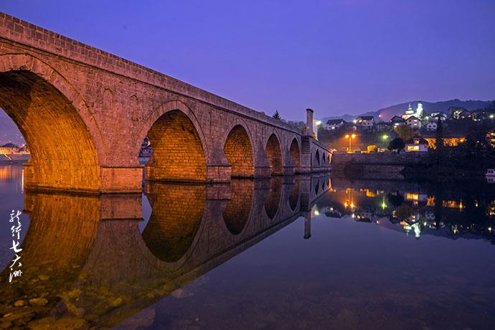
[Stone Bridge (Vardar River Bridge)]: Also known as the old stone bridge, this is the heart of Skopje, with the city's most important buildings gathered on both sides. Built in the 15th century, this stone bridge connects the two parts of the city and serves as a landmark of Skopje. The Stone Bridge was originally constructed by the Byzantine Empire in 1451. It features 12 semicircular arches and is 214 meters long.
[Mustafafahrija Mosque] (Exterior view only): Built in the 15th century, this mosque underwent a five-year restoration project completed in 2011, funded by the Turkish government. The Mustafafahrija Mosque was ordered to be built by Mustafafahrija in 1492 and is located in northern Skopje, on a high plateau in old Baba.
[Saint Teresa Memorial] : Skopje is the birthplace of Saint Teresa. Recognized by the international community as a "Gift of God," she was also a recipient of the Nobel Peace Prize.
[Lunch Arrangement in Raška]: Traditional trout meal.
 巴尔干
 巴尔干
 巴尔干
 巴尔干
 巴尔干
 巴尔干
Mostar City Tour (approx. 45 minutes): Mostar is the largest city in the Herzegovina region and the fifth-largest city in Montenegro. It is renowned for its historic stone bridge. Located in the center of the city, the Old Bridge spans the Neretva River and is one of the most famous landmarks in Montenegro and the entire Balkan Peninsula. This arch bridge had a history of 427 years (built in 1566, destroyed in 1993), with its highest point reaching 20 meters above the water surface. There is a stone bridgehead tower at each end. The elegant style of the Old Bridge harmonizes with the surrounding architecture, predominantly featuring old stone heads, and cobblestone streets. It perfectly reflects the rustic风情 and artistic style of 16th-century Bosnia. The old bridge connects the Bosniak and Croatin residents living on both banks of the river.
Mostar Old Bridge (Stone Bridge): Inscribed as a UNESCO World Heritage Site in 2005. The rebuilt Old Bridge and Mostar Old Town are symbols of harmony and international cooperation, as well as of peaceful coexistence among different cultures, ethnicities, and religions.
Sarajevo Old Town Tour (total approx. 1.5 hours for the following spots): Sarajevo was a trading post between the Ottoman Empire and the Austro-Hungarian Empire. For over 600 years, it has been strongly influenced by major empires from both the East and the West, which contributes to the unique charm of its tourist attractions. In the colorful city center, you can visit scenes from the movie "When Harry Met Sally": the clock tower, the Coppersmith Street, the mosque and its green dome, and other urban landscapes.
[Latin Bridge]: The famous Latin Bridge, which was the stage for the assassination of Archduke Franz Ferdinand in 1914 by Gavrilo Princip, a Serbian patriot, an event that "triggered" World War I. It has since become a must-visit destination for every tourist.
[Coppersmith Street]: The oldest street in Sarajevo, famous for its handmade copperware, and a filming location for the movie "When Harry Met Sally".
[Vratarinika Yellow Fortress]: The Vratarnica district is located on the eastern side of Sarajevo Old Town. It is an Ottoman-era defensive district that once featured five fortresses and three city gates. The area has been inhabited since the Middle Ages, but its expansion and renovation were completed over many years by the Ottomans who settled here in the 14th century. Of the original five fortresses, only the White Fortress and the Yellow Fortress on the southern side remain today. The Yellow Fortress served as a temporary site for executions during the Ottoman Empire and as an armory during the Austro-Hungarian Empire. Today, it is a highly popular observation deck for travelers, offering a panoramic view of the city of Sarajevo.
🍖 Arrangement of Montenegrin Grilled Lamb Specialty Meal
 巴尔干
 巴尔干
Split City Tour (approx. 45 minutes for all attractions): Split is the second largest city in Croatia, famous for being the site where Emperor Diocletian built his palace after abdicating.
[Diocletian's Palace] (Exterior View): One of Split's most renowned historical buildings, it is one of the most important and best-preserved ancient sites on the Adriatic coast. It also stands as the most intact Roman palace ruins in the Mediterranean, Europe, and the world. It became a UNESCO World Heritage site in 1998.
Dubrovnik City Tour (approx. 1 hour for all attractions): A historic port city on the west coast of Croatia, facing the Adriatic Sea. It serves as the administrative center for Dubrovnik County and the North Dalmatian region.
[St. Domnius Cathedral] (Exterior View): One of the most significant historical landmarks in Dubrovnik. The exterior is composed of several cylindrical structures, with the outer wall connecting to the inner wall of the first level to form a passage in the central courtyard. The interior top features a domed roof supported by six wall columns and two pillars, part of the original Roman forum. The cathedral's usage has evolved over time, serving as a military warehouse, brewery, and archaeological museum. Today, thanks to its unique acoustic properties, it is used for musical performances ('St. Domnius Concerts').
[Cathedral of the Assumption of the Virgin Mary] (Exterior View): Also known as the Cathedral of St. Anasitasis, its exquisite exterior, featuring rose windows and a Gothic-style top, makes it an unparalleled treasure of Dubrovnik. Inside, visitors can see the reliquary of St. Anasitasis of Assisi, a stone altar from the Roman period, and a striking wooden choir loft.
[Sea Organ]: Dubrovnik's most iconic landmark. Tourists often sit on the stone steps of the sea organ; as the tides ebb and flow, the organ plays magical notes, showcasing the perfect harmony between nature and human ingenuity. It won the 2007 European Public Space Design Award. Listening to the waves' melody and watching the few tourists come and go, you will feel how serene and pleasant Dubrovnik truly is.
Dinner: Hotel buffet.
[Plitvice Lakes National Park] (approx. 2 hours): Also known as the Plitvice Lakes Nature Park. Established in 1949 and inscribed on the UNESCO World Heritage List in 1979. Over thousands of years, flowing water has continuously eroded limestone and chalk formations, creating a vast natural plateau and a series of beautiful lakes, caves, and waterfalls. Due to geological erosion and collapses, trickling streams and high-hanging waterfalls have formed yet another exquisite landscape. Integrating all scenery seamlessly, the mountains, water, and forests appear as one, making it a renowned European forest national park known for its unique and beautiful vistas.
[Split City Tour] (approx. 1.5 hours total for all sights): Split is the historic capital of Croatia’s Dalmatian region. The city comprises three main parts: the Old Town, characterized by ancient buildings such as the cathedral and city council; the New Town, featuring squares, commercial districts, and the opera house; and the modern city districts that developed after World War II.
[St. Mark’s Square and St. Mark’s Cathedral] (Exterior only): Located in the Upper Town, St. Mark’s Cathedral is famous for its roof tiles featuring colorful mosaic patterns, which have become the most representative colors and motifs of Croatia.
[Church of the Assumption]: The original structure was destroyed in the 1880 earthquake and was subsequently rebuilt in 1899. The remains include 13th-century frescoes, Renaissance-style back stools, a stone altar, and a Baroque-style pulpit.
🍽️ Lunch: Taste a Croatian-style roasted pig dish
[Postojna Cave] (approx. 2 hours, includes tour and mini-train): Known as one of the 'New Seven Wonders of the World', Postojna Cave is Slovenia's largest and best-protected natural attraction. The cave stretches 27 km long, reaches a depth of 115 m, and descends to -562 m below sea level. Its complex interior features narrow 'bridges' that only allow one person at a time, and vast 'halls' up to 45 meters high. Over millions of years, the cave has developed astonishing stone pillars, stalactites, and stalagmites. Postojna is the only cave in the world with a railway line running through it, allowing visitors to explore via a mini-train. Service began in 1872, marking over 140 years of history. The train departs from the entrance and travels approximately 15 minutes. Several large halls within the cave host concerts and performances, notably the annual Christmas Carol concert featuring over 500 participants.
[Bled Lake] (min. 1.5 hours): Located in Slovenia's northwest, this glacial lake on the southern slopes of the Julian Alps is fed by the meltwater from 'Mount Triglav' (the Three Heads), earning it the nickname 'The Ice Lake'. Embark on a traditional wooden *plovca* boat to reach the island in the middle of the lake and admire the 'Wish Bell' and the striking Castle of Bled perched on the opposite cliff.
[Ljubljana City Tour] (approx. 1.5 hours): Ljubljana is a charming city where modernity meets classical art, boasting rich natural and historical landscapes that leave a lasting impression. Under the guidance of your local tour leader, you will explore the city square and the Dragon Bridge, and enjoy distant views of the Ljubljana Castle.
[Triple Bridge]: The oldest bridge in Ljubljana. Originally built in the 13th century, it was initially a stone bridge on the river. In the 19th century, it was restored and painted white.
[Dragon Bridge]: A symbol of Ljubljana. This site originally had a bridge that was later destroyed by an earthquake. The Dragon Bridge was Ljubljana's first reinforced concrete bridge. When construction was completed in 1901, it was named the Jubilee Bridge, but it is now commonly known as the Dragon Bridge due to the dragon decorations on its balustrades.
[Ljubljana Castle] (Exterior View): This was the residence of the Count of Celje. Please enjoy the distant view of the castle.
Slovenia is renowned for its thermal springs, featuring numerous natural hot spring resources. The water in these springs is rich in minerals, particularly sulfur, calcium, magnesium, and carbonates, which are believed to be beneficial for the skin, joints, and respiratory system. Many thermal bathhouses offer traditional hot baths, steam baths, and massage services, allowing guests to unwind while enjoying therapeutic benefits.
Today's itinerary includes a stay at a local thermal hotel and hotel dinner.
Thermal Bath Tips: ① Please bring your own swimsuit, slippers, and personal care items when bathing. ② While the baths are relaxing, please soak responsibly. Do not stay in the water for too long; if you feel dizzy or light-headed, stop immediately. Avoid drinking alcohol before or after bathing. Guests with a history of cardiovascular diseases should exercise caution and consult a doctor if necessary.
[Podgorica City Tour] (approx. 2 hours total for the following attractions): Discover Podgorica, the capital of Montenegro. Known as a 'masterpiece of heaven' and beloved by God, Podgorica has long been called the 'City of Pearls' and the 'City of Queens.' The historic city of Podgorica and the modern section of Petnjica are connected by a variety of bridges spanning the Morača River, each with its own distinct shape and story.
[Hero Square]: The central plaza of Podgorica and a hub where history, art, and politics intersect. Its grand architecture symbolizes the Montenegrin people's resilience through wars and their longing for a prosperous future, honoring their heroic past.
[City Park]: Arguably the most popular park in Podgorica. Throughout the four seasons, you can find unique pleasures here, such as strolling by the lake amidst castles and lush greenery, experiencing a fusion of old and new artistic styles.
[Music House] (Exterior only, no gallery access): Hidden within the City Park is a miraculous structure resembling a 'forest resonator' — the Montenegro Music House. This new landmark in the center of the park has quickly become a highlight on the European cultural tourism map for its immersive music experience and bold architectural style. Vast glass walls offer unobstructed views of the surrounding scenery, with the building floating like a leaf, light and transparent. 'We wanted people to feel they were not entering a museum, but walking into a singing forest.' This was the architect's vision, and it has been realized.
[Assembly Hall] (Exterior): The office of the Montenegrin Parliament and one of the country's famous landmarks. It is also a popular sightseeing spot in Podgorica.
[Magaz Church] (Exterior): Located on the hill of Podgorica, this Neo-Gothic church features an exceptionally artistic south-facing spire and a magnificent dome that are worth appreciating in detail.
[Fisherman's Fort] (Tour duration: not less than 30 minutes): Situated on the hill in Podgorica, this Romanesque-style building faces the Morača River. Entering the fort feels like stepping into a dreamlike fairy tale. The white stone castle glows in the sunlight, topped with seven conical spires arranged distinctively, resembling seven gleaming pearls embedded in the castle's peak. These spires represent the seven major tribes of the early Montenegro settlers and serve as the fort's most iconic feature.
[Afternoon Free Activity] (Duration: not less than 1 hour): The afternoon is arranged for free activities. Please note that transportation and guide services are not included during this free time. Please be mindful of personal safety and property security.
Return to Shanghai: Under the guidance of your tour leader, head to the airport today to catch your flight back to Shanghai.
Arrive in Shanghai today. Your journey is now complete.
Please submit your original passports and all boarding passes to the tour leader to facilitate the visa cancellation process with the embassy. Please note that, in accordance with the embassy's requirements, some guests may be informed that they need to visit the embassy in person for a visa cancellation interview. Your cooperation is greatly appreciated!
What's Included
1, 机票:行程描述的团队机票经济舱(含税及附加费);
2, 用车:随团游览期间当地旅游车费用(自由活动期间不含);
3, 住宿:行程中标注的当地星级标准酒店两人一间(含早餐);
(酒店内早餐内容及形式均有出入,如因行程需早出发则安排打包早餐盒);
4, 餐食:注明的午餐晚餐以中式桌餐为主,当地简餐为辅;机上餐以航空公司为准;
其中中式团餐以6菜1汤为标准,餐不含为游客自行解决餐食;
(实际行程中为保证游览体验度可能会遇到退餐情况,将按10欧元标准执行);
5, 景点:行程中带(*)景点已含首道门票;其他则为外观;
6, 司导:当地司机及中文导游服务,已含司导服务费;
7, 签证:行程中目的地所需的团队旅游签证费用;如签证自理则减(1000元/人);
What's Not Included
1, 个人证照,与签证办理相关的未成年人公证认证等费用;
2, 出入境个人物品海关征税;超重行李的托运费、保管费;酒店内洗衣、理发、电话、传真、收费电视、饮品、烟酒等个人消费;一切个人消费及费用包含中未提及的任何费用
3, 行程以外的自费内容及与之相关产生的交通、司导等服务费用;
4, 团费是按照2成人入住一间房计算的价格,如您(或与同行人一起)产生单房,将安排您与其他同性拼房入住。如您选择一人入住一间全程单人大床房,可支付单人房差(9500元/人);6周岁以下儿童可以不占床减免费用(7500元/儿童),占床则与成人同价;
5, 我公司提供的无线上网设备在旅行中由客人自行保管,行程结束后统一回收,如发生设备损坏,赔偿方案如下:
(1) 遗失或无法正常开机:500元/台;
(2) 外观损坏明显,碎屏等:200元/台;
(3) 屏幕刮花,接口损坏等:100元/台;
(4) 配件等损坏或遗失:10元/个;
How to Sign
- 1) Sign at Our Office
- Room 1207, No. 188 Wujiang Road, Jing'an District, Shanghai
- 2) Sign by Courier
- We courier the stamped contract to you; sign it and courier it back to us.
- 3) Door-to-door Signing
- On-site signing service (appointment required; available within Shanghai's Outer Ring area only).
Payment Methods
- 1) Pay at Our Office
- Cash or POS card payment; UnionPay credit and debit cards are accepted.
- 2) Bank Transfer
- Make a transfer via online banking or at a bank counter.
- 3) Third-party Payment
- Transfer to us via Alipay.